Sunday, March 23, 2014

The Origin of Qing Ming

The beginning of Qing Ming was based on a sad story about a man whose name was Jie Zitui, a faithful servant of a Duke named Wen. Jie was so faithful that when his lord and him could hardly find any food, he prepared a meat soup made of his own thigh. His lord found out that Jie had sacrificed his own thigh for him, then he promised Jie that once he succeeded in becoming King, he would reward Jie for his loyalty.
Jie who didn’t want any reward resigned not long after his lord became a Duke and lived in a forest with his mother. The Duke looked for Jie, but he couldn’t find him so that he ordered his servants to burn the forest in order to force Jie out. Unfortunately, the fire didn’t only force Jie to get out of the forest but also killed him. Then, the remorseful Duke Wen ordered the villagers not to use fire and eat only cold food for three days to commemorate Jie’s death.

Wednesday, March 19, 2014

MH370

After more than 10 days and numerous theories as to the whereabouts of Malaysia Airlines (MAS) flight MH370, the Business Insider has reported of an alternative theory proposed by a former pilot, which has emerged as a very plausible cause for the disappearance of the aircraft.
A few days ago, American Chris Goodfellow had written his simple case on his Google+ page on what he believed happened to the missing aircraft.
Goodfellow had based his theory on the key information of the turn back move shortly after the aircraft had left Malaysian airspace off the east coast of Peninsular Malaysia.
His theory suggests that all relevant officials, investigators and the international media are overthinking the incident behind the disappearance of flight MH370.
Based on Goodfellow's theory, the following is what could have transpired on board the aircraft, and more specifically in the cockpit:
  • Shortly after takeoff, as MAS flight MH370 was flying out over the South China Sea, smoke began filling the cockpit, perhaps from a tyre on the front landing gear that had ignited on take-off.
  • The captain immediately did exactly what he had been trained to do, that is to find the closest airport and turn the plane toward it so he could land.
  • The closest appropriate airport was in Pulau Langkawi, as it had a massive 13,000-foot runway that could cater for the Boeing 777-200. The pilot was likely to have known that beforehand, as any experienced pilot with more than 18,000 flying hours under his belt would.
  • The captain programmed the destination into the flight computer. The auto-pilot turned the plane west and put it on a course right for the runway.
  • The pilot did not consider returning to Kuala Lumpur International Airport because the plane would have to cross over a mountain range in between. He knew the terrain to Langkawi would be friendlier and also a shorter distance to cover.
  • The captain and co-pilot tried to find the source of the smoke and fire, but it soon filled the cockpit and overwhelmed them (a tyre fire would do this).
  • Such a fire could also short-circuit the cockpit systems one by one, including the transponder. Quite possibly, both pilots had passed out or died by then.
  • With no one awake to instruct the auto-pilot to land, the plane kept flying on its last programmed course... right over Pulau Langkawi and out over the Indian Ocean.
  • Eventually, six or seven hours after the incident, it ran out of fuel and crashed.
This pilot was a hero struggling with an impossible situation trying to get that plane to Langkawi. No doubt in my mind. That's the reason for the turn and direct route.
Goodfellow further elaborated that Captain Zaharie Ahmad Shah did all the right things.
"He was confronted by some major event onboard that made him make that immediate turn back to the closest safe airport.
"For me the loss of transponders and communications makes perfect sense if in the event of a fire, and especially an electrical fire. The first response is to pull all the main busses and restore circuits one by one until you have isolated the bad one.
"However, if they pulled the busses, the plane indeed would go silent. It was probably a serious event and they simply were occupied with controlling the plane and trying to fight the fire.
"Aviate, navigate and lastly communicate," Goodfellow wrote on the priority that is set for pilots to follow in the event of any emergency.
According to Goodfellow's theory, one possibility, given the timeline on how the fire started and then spread is that perhaps there was an overheat on one of the front landing gear tires and it blew on takeoff and started slowly burning. This could happen with under-inflated tires.
He added: "This pilot was a hero struggling with an impossible situation trying to get that plane to Langkawi. No doubt in my mind. That's the reason for the turn and direct route.
"A hijack would not have made that deliberate left turn with a direct heading for Langkawi. It would probably have weaved around a bit until the hijackers decided on where they were taking it.
"Surprisingly none of the reporters, officials and other pilots interviewed have looked at this from the pilot's viewpoint. If something went wrong where would he go? Thanks to Google Earth, I spotted Langkawi in about 30 seconds, zoomed in and saw how long the runway was and I just instinctively knew this pilot knew this airport.
"He had probably flown there many times. Also, another good clue would be the age and number of cycles on those nose tyres."
According to Business Insider this theory fits the facts and makes sense, most especially because it explains the manual course change as well as the "pings" that a satellite kept hearing from the plane hours after the communications systems went down. – March 18, 2014.

http://my.news.yahoo.com/pilot-may-tried-save-plane-heading-langkawi-airport-135747514.html

Friday, February 21, 2014

Periodontal scaling

Current treatment for periodontitis involves scraping dental plaque, the polymicrobial biofilm, off the tooth, a procedure called scaling. Root planing involves scaling the tooth’s root. Scaling and root planing are often referred to as deep cleaning.

The objective for periodontal scaling and root planing is to remove dental plaque and calculus (tartar), which house bacteria that release toxins which cause inflammation to the gum tissue and surrounding bone. According to Brentwood periodontists, Dr. Alina Krivitsky and Dr. Alexandre Aalam, scaling and root planing is one of the most effective periodontal methods of treating gum disease before it becomes severe.

However, according to the Evidence-Based Dentistry website, the Cochrane Oral Health Group in 2005 found two relevant studies, with neither showing any clinical benefit to scaling.[3] In 2013 the Cochrane Oral Health Group examined three new studies. The most pertinent study found no benefit for regular scaling treatments when compared to a no-scale regimen.

Also, cleaning pockets deeper than 2mm is difficult, and the deeper the pocket, the harder it is to clean effectively. Since a periodontal pocket is defined as 4mm or more, scaling and root planing are ineffective at cleaning the deep pockets associated with periodontitis. Thus, the deep cleaning that scaling and planing is supposed to provide is not deep at all, and probably has little impact, if any, on gum disease.

Because in periodontal disease pockets form that are deeper than the usual gingival depth, such scaling and root planing are often referred to as deep cleaning, and may be performed using a number of dental tools, including ultrasonic instruments and hand instruments, such as periodontal scalers and curettes.
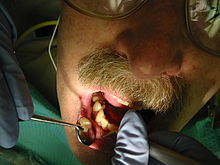
A dental hygienist demonstrates scaling.

Removal of adherent plaque and calculus with hand instruments can also be performed prophylactically on patients without periodontal disease. A prophylaxis refers to scaling and polishing of the teeth in order to prevent oral diseases. Polishing does not remove calculus, but only some plaque and stains, and should therefore only be done in conjunction with scaling.

Often, a device may be electric, known as an ultrasonic or sonic scaler. Ultrasonic scalers vibrate at a frequency that breaks down bacterial cell membranes and removes both plaque and calculus. Hand instruments are used to complete the fine hand scaling that removes anything the ultrasonic scaler left behind.

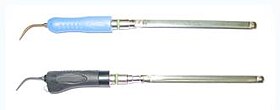
Two ultrasonic instruments.

Sonic and ultrasonic scalers are powered by a system that causes the tip to vibrate. Sonic scalers are typically powered by an air-driven turbine. Ultrasonic scalers typically use either magnetostrictive or piezoelectric systems to create vibration. Magnetostrictive scalers use a stack of metal plates bonded to the tool tip. The stack is induced to vibrate by an external coil connected to an AC source. Ultrasonic scalers also include a liquid output or lavage, which aids in cooling the tool during use, as well as rinsing all the unwanted materials from the teeth and gum line. The lavage can also be used to deliver antimicrobial agents.

Although the final result of ultrasonic scalers can be produced by using hand scalers, ultrasonic scalers are sometimes faster and less irritating to the client. Ultrasonic scalers do create aerosols which can spread pathogens when a client carries an infectious disease. Research shows no difference in effectiveness between ultrasonic scalers and hand instruments. Of particular importance to dentists themselves is that the use of an ultrasonic scaler will greatly decrease their likelihood of getting carpal tunnel syndrome (or other similar forms of RSI).

Thursday, February 13, 2014

Valentine's Day History

The origins of Valentine's Day trace back to the ancient Roman celebration of Lupercalia. Held on February 15, Lupercalia honored the gods Lupercus and Faunus, as well as the legendary founders of Rome, Romulus and Remus.

In addition to a bountiful feast, Lupercalia festivities are purported to have included the pairing of young women and men. Men would draw women's names from a box, and each couple would be paired until next year's celebration.

While this pairing of couples set the tone for today's holiday, it wasn't called "Valentine's Day" until a priest named Valentine came along. Valentine, a romantic at heart, disobeyed Emperor Claudius II's decree that soldiers remain bachelors. Claudius handed down this decree believing that soldiers would be distracted and unable to concentrate on fighting if they were married or engaged. Valentine defied the emperor and secretly performed marriage ceremonies. As a result of his defiance, Valentine was put to death on February 14.

After Valentine's death, he was named a saint. As Christianity spread through Rome, the priests moved Lupercalia from February 15 to February 14 and renamed it St. Valentine's Day to honor Saint Valentine.

http://www.care2.com/gates/holidays/valentines/valentines.html

Friday, January 17, 2014

Horse

Personality

  • Lucky Colors: green, red, purple
  • Lucky Numbers: 3, 4, 9
  • Lucky Flowers: giant taro, jasmin
  • Year of Birth: 1918, 1930, 1942, 1954, 1966, 1978, 1990, 2002, 2014, 2026
The horse ranks seventh of all the animals in the Chinese zodiac. People born in the year of the horse are extremely animated, active and energetic. Horses love to be in a crowd, and they can usually be seen in such occasions as concerts, theaters, meetings, sporting occasions, and parties. With a deft sense of humor, horses are masters of repartee. They love to take center stage and delight audiences everywhere.
Sometimes, the horse is a little self-centered, but it doesn't mean that he will not be interested in any problems except his own. However, a horse person is really more cunning than intelligent, that is probably due to the fact that most horse people lack confidence.

Health

Basically, horse people are very healthy, most likely because they hold a positive attitude towards life. However, heavy responsibility or pressure from their job may make them weak. Therefore horse people shouldn't do overtime too often and then come home very late. Also, they should refuse some invitations to join parties at night. 

http://www.chinahighlights.com

Sunday, January 12, 2014

Cardiac Arrest

Introduction to sudden cardiac arrest


A natural disaster hits, the power goes off and the lights go out. It's a common scene that plays out during hurricane and tornado seasons, and it's very similar in trying to explain sudden cardiac arrest. The heart sustains an insult, the electricity is short circuited, the heart can't pump, and the body dies.
The heart is an electrical pump, where the electricity is generated in special pacemaker cells in the upper chamber, or atrium, of the heart. This electrical spark is carried through pathways in the heart so that all the muscle cells contract at once and produce a heart beat. This pumps blood through the heart valves and into all the organs of the body so that they can do their work.
This mechanism can break down in a variety of ways, but the final pathway in sudden death is the same: the electrical system is irritated and fails to produce electrical activity that causes the heart to beat. The heart muscle can't supply blood to the body, particularly the brain, and the body dies. Ventricular fibrillation (V Fib) is the most common reason for sudden death in patients. Without a coordinated electrical signal, the bottom chambers of the heart (ventricles) stop beating and instead, jiggle like Jello. Ventricular Fibrillation is treated with electrical shock, but for it to be effective, the shock usually needs to happen within less than four to six minutes, not only for it to be effective, but also to minimize brain damage from lack of blood and oxygen supply. Automatic external defibrillators (AEDs) are commonly available in public places to allow almost anybody to treat sudden death. Less commonly, the heart can just stop beating. The absence of a heart beat is known as asystole (asystole: a=no + systole=beat).

http://www.medicinenet.com/
Related Posts with Thumbnails